
Concepts
Scope and sequence: how phonics is ordered
A phonics scope and sequence lists what will be taught and the order in which it will be taught.
What it is
A phonics curriculum needs to answer two questions:
- Which skills and letter-sound patterns will be taught?
- In what order will they be taught?
The answer to the first question is the scope. It can include consonant sounds, short vowels, digraphs such as sh, vowel teams, syllable types, and word endings.
The answer to the second question is the sequence. It places those skills in a planned teaching order.
Together, the scope and sequence provide a shared map for instruction.
Why the order matters
A systematic sequence introduces skills in a planned order. It is also cumulative: students continue using earlier skills while they learn new ones.
For example, a curriculum may teach common consonant sounds and short vowels before more complex vowel patterns. This lets students build new learning on patterns they have already practiced.
There is no single lesson order used by every phonics curriculum. Two programs may teach the same patterns at different times. That is why a lesson number is not useful without the curriculum name.
In short: the sequence gives new learning a planned place, but the exact order depends on the curriculum.
What Cody does with it
When you create from a Lesson, Cody uses the curriculum and lesson you selected. Patterns from earlier lessons are treated as available, while the current lesson supplies the focus patterns.
When you create for a Student, Cody uses the student’s current lesson and pattern profile. The profile has three states:
- Known patterns may be used.
- Target patterns receive extra practice.
- Unknown patterns are avoided when possible.
The current lesson helps Cody set these states, and the pattern grid shows the result. See Reading the pattern grid.
Keep the student’s position accurate
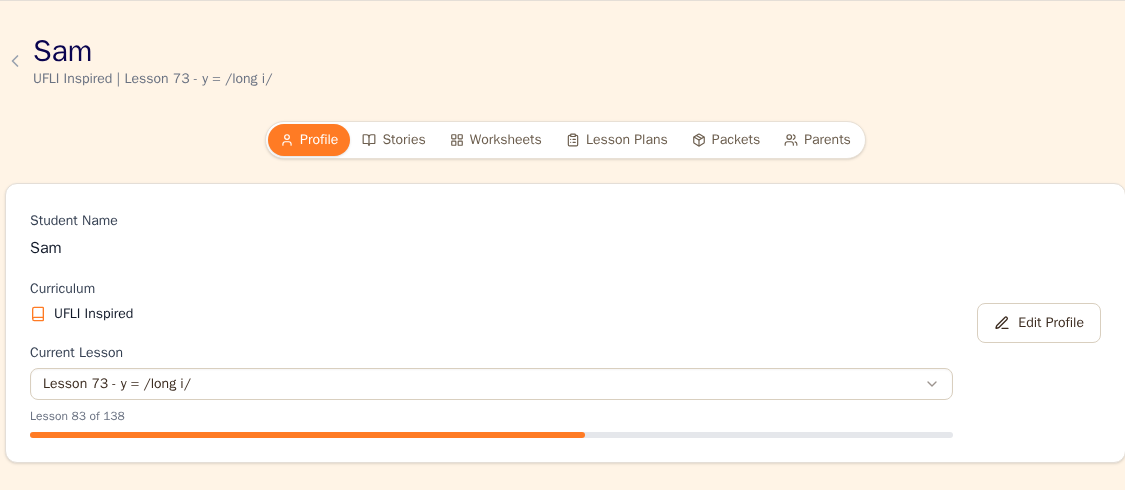
Cody cannot observe what a student can read. It uses the current lesson and the pattern states saved in the student’s profile.
Changing Current Lesson re-syncs the profile: patterns from earlier lessons become Known and patterns in the selected lesson become Target. Patterns later in the sequence remain Unknown.
After changing the lesson, open Phonetic Patterns and check the grid. Adjust any pattern that does not match what the student can currently use.
If material feels too hard or too easy, check these three things:
- The student’s curriculum.
- Their Current Lesson.
- The Known, Target, and Unknown states in the pattern grid.
In short: the sequence provides the starting map; the student’s current profile must still reflect the reader in front of you.
When your teaching doesn’t match any sequence
Your teaching may not follow one listed curriculum from beginning to end. This is common in intervention work or when a student joins partway through a year.
Cody includes Custom Pattern Selection for this situation. You begin from a broad starting level, then manage the student’s pattern states directly instead of moving them through a normal lesson list.
Changing a student’s curriculum clears the pattern progress connected to the old curriculum. Read The curricula Cody supports before making that change.
Still stuck? If something is broken rather than confusing, tell us what happened and we will look into it.