
Concepts
Decodable text: what it is and why it matters
Decodable text lets a reader practice the letter-sound patterns they have already learned in complete sentences and stories.
What makes a text decodable
Start with a reader who knows short vowels, common consonant sounds, and the pattern sh.
That reader can sound out a fish in a dish. The sentence uses patterns they already know.
The word rain may not be decodable yet if the reader has not learned the vowel team ai. The word may be familiar when spoken, but its spelling pattern is still new.
This is why decodability is about both the text and the reader.
Decodable is about a reader, not a book
A book is not equally decodable for every student. The same page can fit a student who has learned sh and be too early for a student who has not.
The match also changes over time. As a student learns more patterns, more words become available to them.
When you create for a student, Cody uses that student’s pattern profile. The same story can receive a different decodability result for another student, even though the words have not changed.
In short: decodability is a match between a text and a reader at a particular point in their learning.
Why teachers use decodable text
Learning a phonics pattern in isolation is only one step. A student also needs to use that pattern while reading connected text: phrases, sentences, and stories where the words carry meaning together.
Decodable text gives the student that practice without surrounding the target pattern with too many patterns they have not learned. It can support accurate reading, repeated practice, and growing fluency.
It is still only one part of reading instruction. Students also need rich language, vocabulary, comprehension work, and books read aloud to them.
In short: decodable text gives students a controlled place to apply phonics; it does not replace the rest of reading instruction.
Decodable, leveled, and predictable are different
These labels describe different ways of choosing or writing a text.
| Type | What guides the text | What to check |
|---|---|---|
| Decodable | Letter-sound patterns the reader has learned | Does it match this student’s patterns? |
| Leveled | Overall difficulty, such as vocabulary and sentence length | Does it include spelling patterns the student has not learned? |
| Predictable | Repeated wording or sentence frames | Is the student reading the words or relying on the repeated phrase? |
A text can fit more than one description. For example, a story can have simple vocabulary and also match the student’s phonics patterns.
In short: a reading level describes general difficulty; decodability checks whether this reader has learned the patterns in the words.
Why the wording can sometimes sound unusual
Early readers know a small set of spelling patterns. Writing with only that set limits the words available, so some decodable text can sound repetitive or unnatural.
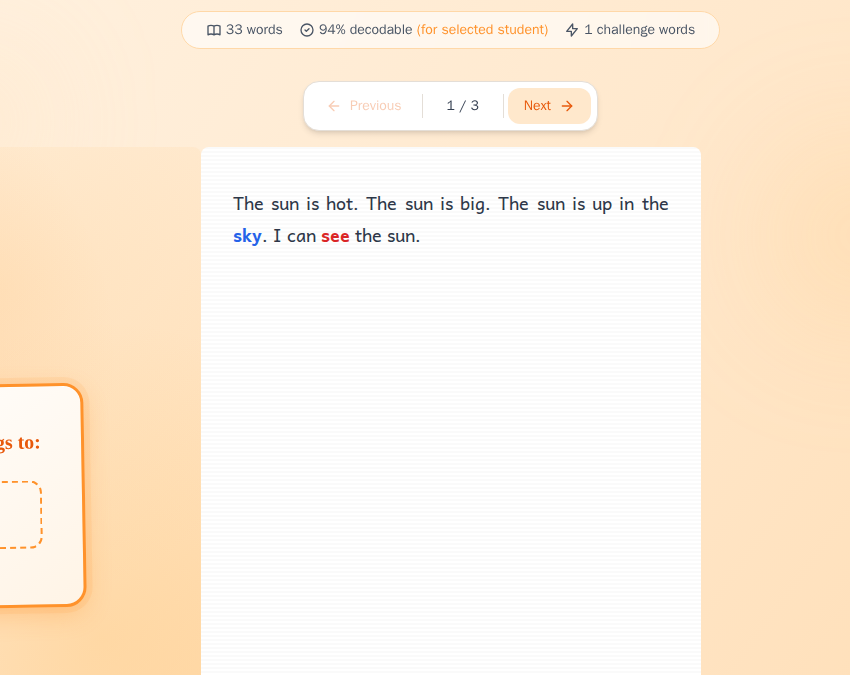
Cody tries to balance the phonics boundary with a readable story. It may use some recognized sight words and a small number of words outside the student’s current patterns.
Those outside words appear as Unknown words in red. Review them before you use the story. You may decide to explain a word, edit it, or create another version.
For a full explanation, see How decodability scoring works.
Still stuck? If something is broken rather than confusing, tell us what happened and we will look into it.